
Diamond Sources
DiamondAvenue.com - Find the Locations of Major Diamond Discoveries and Mines
Where Diamonds Are Found Around the World
Natural diamonds occur in many parts of the world, but economically important deposits are concentrated in particular geological regions.
Some diamonds are recovered directly from kimberlite or lamproite pipes, the volcanic rocks that transported diamonds toward the Earth's surface.
Others are recovered from secondary deposits, where erosion and moving water transported diamonds away from their original host rocks into rivers, beaches, gravels or even offshore seabeds.
Different producing regions have become known for particular qualities of rough diamonds, including exceptional size, high color and clarity, fancy colors or large volumes of industrial material.
Major Diamond-Producing Regions of the World
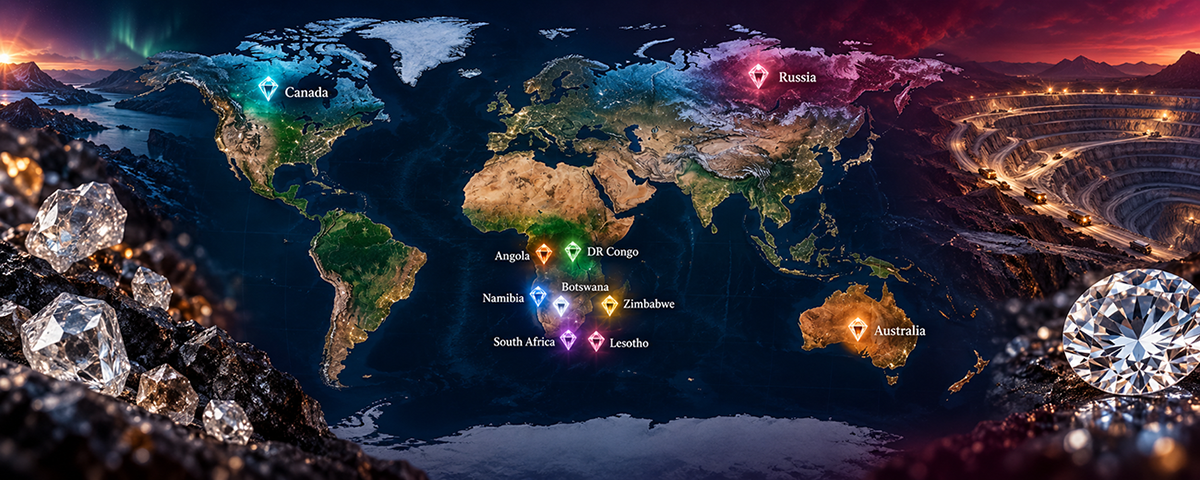
Important historic and modern diamond sources include southern Africa, central Africa, Russia, Canada, Australia, India and Brazil.
The character of the diamonds recovered from these regions can differ because of geology, transportation, crystal chemistry and the nature of the deposits.
How Diamonds Form in the Earth
Natural diamonds formed deep within the Earth under conditions of extremely high pressure and temperature.
Most gem-quality diamonds are believed to have formed at depths of approximately 90 to 150 miles below the Earth's surface, in the upper mantle.
At these depths, carbon atoms were subjected to enough pressure and heat to crystallize into diamond rather than remaining in other forms such as graphite.
Many diamonds are extremely old, often forming hundreds of millions to billions of years ago. After formation, they remained deep within the Earth until rare volcanic events carried them closer to the surface.
Diamond Formation in the Mantle

Diamonds form in the Earth's mantle rather than in the crust where we live.
The illustration above can show:
- The Earth's crust
- The upper mantle
- The approximate depth where diamonds form
- High pressure and high temperature conditions
This helps explain why diamonds are rare at the Earth's surface even though carbon itself is common.
Kimberlite and Lamproite Pipes

Diamonds reach the surface through rare, deep-source volcanic eruptions.
These eruptions create vertical or carrot-shaped bodies of rock called:
- Kimberlite pipes
- Lamproite pipes
These pipes act as natural transport channels, carrying diamonds and other mantle materials upward from great depths.
Many of the world's important primary diamond mines are developed in these pipe-like deposits.
Parts of a Diamond Pipe
A typical diamond-bearing volcanic pipe may be divided conceptually into several parts.
A simplified diagram may include:
- Crater zone near the ancient surface
- Diatreme or pipe zone, the main vertical body of fragmented volcanic material
- Root zone, the deeper feeder area
- Surrounding country rock
- Diamond-bearing kimberlite or lamproite
The classic "carrot-shaped" pipe became one of the most recognizable geological models in diamond mining because so many famous deposits occur in this type of structure.
From Primary Deposit to Secondary Deposit
Not all mined diamonds come directly from volcanic pipes.
Once a kimberlite or lamproite deposit is exposed at or near the Earth's surface, weathering and erosion may begin to break it down.
Because diamond is highly durable, many diamonds survive this process and are transported away from the original pipe by:
- Rivers
- Floods
- Wind and weathering
- Coastal and marine action
These transported diamonds may then accumulate in secondary deposits.
Alluvial and Marine Diamond Deposits

Secondary diamond deposits may occur in:
- River gravels
- Ancient stream beds
- Floodplains
- Coastal beach deposits
- Offshore marine sediments
These are often called alluvial deposits when formed by water transport.
Important examples include the historic alluvial deposits of India and Brazil and the coastal and offshore deposits of Namibia.
Why Diamond Formation Matters
Understanding how diamonds form helps explain why certain regions become important diamond sources and why different deposits produce diamonds with different characteristics.
For example:
- Some kimberlite pipes are known for large, high-quality white diamonds
- Some deposits produce more industrial diamonds
- Some regions are associated with rare fancy colors
- Alluvial and marine deposits may contain especially durable crystals that survived long natural transport
The journey of a diamond therefore begins deep in the Earth's mantle, continues through volcanic transport, and may end either in a primary volcanic pipe or in a secondary river, coastal or marine deposit.
Primary Diamond Deposits
A primary diamond deposit occurs where diamonds remain associated with the volcanic rock that carried them toward the surface.
The best-known diamond-bearing host rocks are kimberlite and, less commonly, lamproite.
These deposits may be mined by:
- Open-pit mining
- Underground mining
- Processing of previously mined material
Famous primary deposits occur in South Africa, Botswana, Russia, Canada, Lesotho and Australia.
Secondary and Alluvial Diamond Deposits
Over long periods of time, erosion can release diamonds from their original host rocks.
Rivers and other natural processes may carry the diamonds considerable distances before depositing them in:
- River gravels
- Floodplains
- Ancient river channels
- Coastal beaches
- Marine sediments
Important secondary diamond deposits occur in Brazil, India, Namibia, Angola and Sierra Leone.
South Africa
South Africa occupies an important place in modern diamond mining because discoveries there during the nineteenth century demonstrated that diamonds could occur in volcanic host rocks rather than only in river deposits.
The country's diamond deposits include both primary kimberlite mines and secondary deposits.
Important historic and modern mining areas include:
- Kimberley
- Cullinan
- Venetia
- Orange River deposits
South African deposits have produced many large, high-quality diamonds.
The Cullinan Mine
The Cullinan Mine, formerly known as the Premier Mine, is one of the world's most famous diamond sources.
It is particularly noted for large, high-quality diamonds and is also an important source of rare Type IIb blue diamonds.
The mine produced the Cullinan Diamond in 1905.
The original rough diamond weighed approximately 3,106 carats and was later divided into a number of important polished stones.
Among them are:
- Cullinan I
- Cullinan II
- Cullinan III
- Cullinan IV
Botswana
Botswana is one of the world's most important modern diamond-producing countries.
Its major kimberlite mines include:
- Jwaneng
- Orapa
- Letlhakane
- Damtshaa
Jwaneng is particularly important because of the high value of the diamonds recovered from the deposit.
Orapa is one of the world's major open-pit diamond operations and has played a central role in Botswana's diamond industry.
Large Botswana Diamonds
Botswana has also become known for discoveries of exceptionally large rough diamonds.
One of the best known is the Lesedi La Rona, a massive rough diamond recovered in Botswana.
The country continues to be associated with large gem-quality stones as well as substantial commercial diamond production.
Botswana demonstrates that a diamond-producing country can be important both for production volume and for exceptional individual discoveries.
Lesotho - Letšeng Mine
The high-altitude Letšeng Mine in Lesotho is famous for producing unusually large, high-quality gem diamonds.
Although its overall production is smaller than many major mines, Letšeng is especially important because of the exceptional value and size of some of its diamonds.
Notable discoveries include:
- Lesotho Promise - 603 carats rough
- Letšeng Star - 550 carats rough
- Lesotho Legend - 910 carats rough
- Letšeng Princess - 367 carats rough
Letšeng is particularly associated with large, top-color white diamonds.
Namibia
Namibia has one of the world's most unusual diamond resources.
Many Namibian diamonds originated in the interior of southern Africa and were transported westward by the Orange River.
Over geological time, diamonds were carried toward the Atlantic coast and deposited in coastal and marine sediments.
Namibia is therefore known for both:
- Coastal diamond deposits
- Offshore marine diamond deposits
Marine Diamonds
Namibia has become a world leader in offshore diamond recovery.
Specialized mining vessels recover diamonds from diamond-bearing sediments on the Atlantic seabed.
The long natural journey through rivers and coastal environments tends to destroy weaker crystals, so the diamonds that survive transportation can be unusually durable and of high gem quality.
Namibia is particularly well known for high-quality gem diamonds recovered from these marine and coastal deposits.
Angola
Angola contains important primary and alluvial diamond deposits.
Major producing areas include the northeastern part of the country, where both kimberlite and river deposits occur.
The country has become particularly well known for discoveries of unusually large diamonds.
Important mining areas include:
- Catoca
- Lulo
- Other deposits in Lunda Norte and Lunda Sul
Lulo and Exceptional Large Diamonds
The Lulo alluvial diamond field is known for recovering large, high-quality stones, including Type IIa diamonds and fancy colors.
Notable discoveries include:
- 4th February Stone - 404 carats
- Lulo Rose - 170 carat pink rough diamond
Discoveries such as these have helped establish Angola as an important source of exceptional large diamonds.
Sierra Leone
Sierra Leone is famous for rich alluvial diamond deposits.
Important diamond-producing districts occur in the eastern part of the country, particularly around Kono and the Koidu area.
Sierra Leone has produced many large gem diamonds and is historically associated with the Star of Sierra Leone.
Alluvial mining has played an especially important role because diamonds have been concentrated in river gravels and sediments after being eroded from older geological sources.
Democratic Republic of the Congo
The Democratic Republic of the Congo has extensive diamond resources, particularly in central parts of the country.
Many deposits are alluvial and are worked on both industrial and artisanal scales.
The region has historically produced very large quantities of diamonds, including substantial amounts of material suitable for industrial applications.
The DRC is therefore notable more for the scale and diversity of its diamond resources than for association with a particular famous named gemstone.
Russia
Russia is one of the world's major diamond producers.
Much of its production comes from the Republic of Sakha - Yakutia in Siberia.
Major mining districts include areas around:
- Mirny
- Udachny
- Aikhal
Additional diamond deposits occur in the Arkhangelsk region of northwestern Russia.
Siberian Diamond Deposits
Russian deposits are primarily associated with large kimberlite pipes developed in ancient continental rocks.
The Mir Mine became one of the world's best-known open-pit diamond mines.
Russian mines produce substantial quantities of gem-quality diamonds as well as industrial material.
Some Russian deposits are also known to produce pink to purple-pink diamonds.
Canada
Canada emerged as a major diamond-producing country during the late twentieth century following discoveries of diamond-bearing kimberlites in the north.
Important mining areas occur primarily in the Northwest Territories and other parts of northern Canada.
Major mines have included:
- Ekati
- Diavik
- Gahcho Kué
Canadian Diamonds
Canadian mines have become known for high-quality white diamonds and carefully documented mine origin.
The Diavik deposit at Lac de Gras contained several diamond-bearing pipes and produced predominantly white diamonds along with smaller quantities of yellow stones.
Mining at Diavik concluded in 2026 and the site entered its closure and reclamation phase.
Canada's diamond industry is notable for the development of large-scale mining under extremely remote Arctic and sub-Arctic conditions.
Australia - The Argyle Mine
Australia's Argyle Mine in Western Australia became one of the world's most distinctive diamond sources.
Argyle produced enormous quantities of diamonds during its operating life and became particularly well known for:
- Pink diamonds
- Purplish-pink diamonds
- Red diamonds
- Brown diamonds
Pink diamonds represented only a tiny fraction of the mine's production, but their rarity and distinctive appearance made Argyle internationally famous.
The mine ceased production in 2020.
India and the Golconda Region
India was the world's earliest major commercial source of diamonds and supplied important stones for many centuries.
Diamonds were recovered mainly from alluvial deposits associated with river systems in southern and central India.
The historic term Golconda diamonds refers broadly to diamonds associated with the diamond trade and mining regions of the former Golconda kingdom.
The Kollur mining area along the Krishna River is among the most famous historic sources.
Famous Golconda Diamonds
Historic diamonds attributed to the Golconda region include several of the world's most famous gems.
- Hope Diamond
- Koh-i-Noor
- Idol's Eye
- Condé Pink
Exact mine provenance for very old diamonds is not always certain because modern documentation did not exist when many of these stones were recovered.
It is therefore usually more accurate to describe them as originating from the Golconda region rather than assigning a specific mine unless reliable historical evidence supports that conclusion.
Brazil
Brazil became a major diamond source during the eighteenth century after diamonds were discovered in river deposits in Minas Gerais.
Important Brazilian diamond regions include:
- Diamantina
- Coromandel
- Abaeté
- Chapada Diamantina
- Mato Grosso
Much of Brazil's historical production came from alluvial deposits in rivers and gravels.
Famous Brazilian Diamonds
Brazil is especially notable for discoveries of large alluvial diamonds and occasional fancy-color stones.
Famous examples include:
- Star of the South
- Presidente Vargas
- Moussaieff Red
The Star of the South was found in the Bagagem River region of Minas Gerais, while the Moussaieff Red is associated with the Abaeté River region.
Why Diamond Deposits Differ
Diamonds from different deposits can show differences in size distribution, color, crystal form, inclusions and diamond type.
These differences can result from:
- Conditions under which the diamonds originally formed
- Chemistry of the Earth's mantle
- Nitrogen and boron impurities
- Crystal deformation
- The volcanic event that transported the diamonds
- Weathering and erosion
- Transportation through rivers and oceans
For this reason, certain mines become associated with particular characteristics, such as Argyle pinks, Letšeng's large white diamonds or Cullinan's exceptional large and occasional blue diamonds.
Can a Diamond's Mine Be Identified from the Stone Alone?
Geographic origin is much more difficult to determine for diamonds than it is for many colored gemstones.
Once a diamond has entered the supply chain and been cut and polished, its physical characteristics generally do not provide enough information to determine a specific country or mine with certainty.
Mine origin is therefore usually established through documented chain-of-custody information rather than by visual or gemological examination alone.
Exceptionally famous diamonds often have documented provenance because their discovery and ownership history were recorded.
Major Diamond Sources at a Glance
| Region | Major Deposit or Mine Type | Known For | Famous Examples |
|---|---|---|---|
| South Africa | Kimberlite and alluvial deposits | Large, high-quality diamonds; rare blue diamonds | Cullinan |
| Botswana | Kimberlite mines | High-value production and large gem diamonds | Lesedi La Rona |
| Lesotho | High-altitude kimberlite | Large, high-quality white diamonds | Lesotho Promise, Lesotho Legend |
| Namibia | Coastal and marine deposits | High-quality marine diamonds | Primarily known for deposit quality rather than a single famous stone |
| Angola | Kimberlite and alluvial deposits | Large Type IIa and fancy-color diamonds | 4th February Stone, Lulo Rose |
| Russia | Kimberlite pipes | Large-scale production; gem and industrial diamonds | Mir and Yakutia deposits |
| Canada | Kimberlite pipes | High-quality white diamonds | Ekati, Diavik and Gahcho Kué |
| Australia | Argyle lamproite deposit | Pink, red and brown diamonds | Argyle pink diamonds |
| India | Historic alluvial deposits | Historic high-quality Golconda diamonds | Hope, Koh-i-Noor, Idol's Eye |
| Brazil | Primarily alluvial deposits | Large stones and occasional fancy colors | Star of the South, Presidente Vargas, Moussaieff Red |
Explore More Diamond Information
Rough Diamonds | Diamond Types | Diamond Shapes | The Four Cs | Famous Diamonds