
All Brands
Browse a broad selection of diamond eternity rings from jewelry brands & merchants.

Browse a broad selection of diamond eternity rings from jewelry brands & merchants.
Browse diamond eternity rings and jewelry selections from Allurez.
Browse diamond eternity rings and jewelry selections from Auralume.
Explore diamond eternity rings and jewelry selections available from Angara.
Explore diamond eternity rings and jewelry selections available from JewelsForum.
Browse diamond eternity rings and jewelry selections from Jewels By Lux.
Explore diamond eternity rings and fine jewelry selections from Kobelli Jewelry.
Browse diamond eternity rings and jewelry selections available from Pompeii3 Inc.
Explore diamond eternity rings and jewelry selections available from TriJewels.
Browse diamond eternity rings and jewelry selections available from THELANDA.
Explore diamond eternity rings and jewelry selections from WES.
Affiliate Disclosure: DiamondAvenue.com may earn a commission from qualifying purchases made through affiliate links at no additional cost to you.
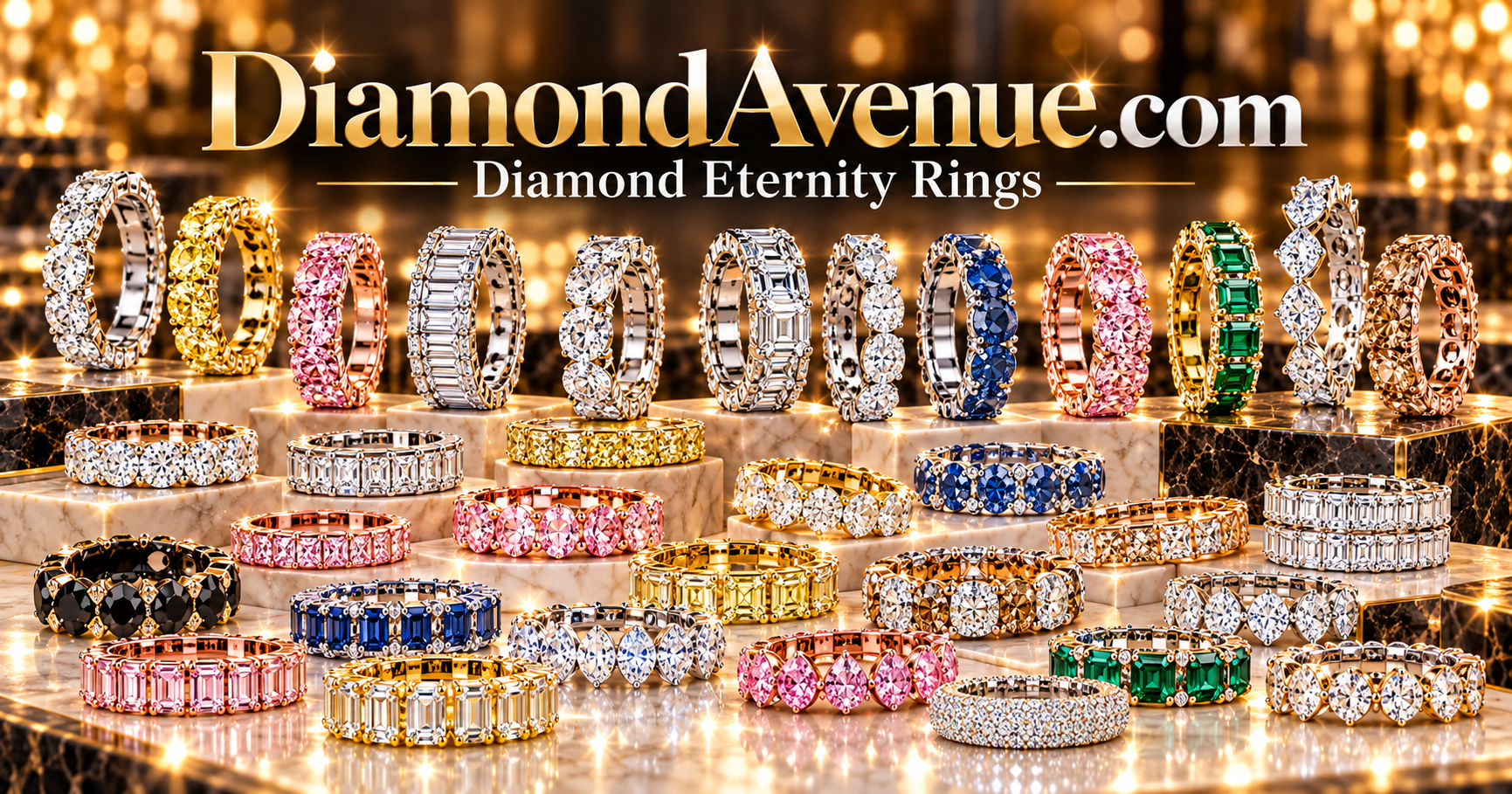
Diamond eternity rings are bands set with diamonds around all or part of the circumference of the ring. Their continuous line of diamonds makes them popular as wedding bands, anniversary rings, stackable rings and special-occasion jewelry.
When comparing diamond eternity rings, consider not only appearance and price, but also diamond quality, matching, total carat weight, setting style, metal type, ring size, comfort and whether the ring can be resized later. These factors can be especially important with eternity rings because the diamonds may extend around much or all of the band.
A full eternity ring has diamonds set around the entire circumference of the band. Because diamonds are visible from every angle, the ring maintains its appearance even if it rotates on the finger.
Full eternity rings generally require more diamonds than partial eternity designs and may therefore cost more. They can also be more difficult to resize because there may be little or no plain metal available for alteration.
A three-quarter eternity ring has diamonds around most of the band while leaving a smaller area of plain metal on the underside of the finger.
This style can provide much of the visual effect of a full eternity ring while sometimes offering greater comfort and more flexibility for future sizing, depending on the design.
A half eternity ring generally places diamonds across the upper half of the band while leaving the lower portion as plain metal.
Half eternity designs may be easier to resize, can be comfortable for everyday wear and often cost less than comparable full eternity rings because fewer diamonds are required.
The same Four C's used to evaluate other diamonds—carat weight, color, clarity and cut—also influence the appearance and value of the diamonds used in eternity rings.
Because an eternity ring contains a row of diamonds positioned directly beside one another, matching is especially important. Differences in size, color, shape or brilliance may be more noticeable when the diamonds are viewed together.
Cut: Cut influences brilliance and sparkle. Well-cut diamonds can create a bright and consistent line of reflected light around the ring.
Color: Diamonds used together in the same ring should appear reasonably consistent in color. A noticeably warmer or more colorless stone may stand out from neighboring diamonds.
Clarity: Clarity refers to internal inclusions and external blemishes. Because many eternity-ring diamonds are relatively small, extremely high clarity grades may not always provide a visible difference without magnification.
Carat Weight: Eternity rings are commonly advertised using total carat weight, meaning the combined weight of all diamonds in the ring. Two rings with the same total carat weight may look different depending on the number and individual size of the diamonds.
Prong settings use small metal supports to hold the diamonds in place. Shared-prong designs allow neighboring diamonds to share supporting prongs, which can reduce the amount of visible metal and create a more continuous line of diamonds.
Because an eternity ring may contain many individual settings, the security and workmanship of the prongs are important. Diamonds should sit evenly and should not appear loose, tilted or irregularly positioned.
Channel settings place diamonds between continuous walls of metal, creating a smooth appearance and helping protect the sides of the stones.
Bezel settings surround all or part of each diamond with metal and can provide additional protection around the stones.
Pavé and micro-pavé settings use many small diamonds set closely together to create a surface of sparkle. With these designs, workmanship and the security of each small stone are particularly important.
Correct sizing is especially important with a diamond eternity ring. A ring that is too loose may rotate excessively or be at risk of slipping off, while a ring that is too tight may be uncomfortable.
Full eternity rings can feel different from plain bands because diamonds and settings may extend between adjacent fingers. The width, thickness, setting height and size of the diamonds all affect comfort.
Whenever possible, obtain an accurate ring size before ordering an eternity band.
Many full eternity rings are difficult or sometimes impractical to resize because diamonds and settings continue around the entire circumference of the band.
Changing the size may require removing or adding diamonds, altering the spacing of the stones or substantially rebuilding the ring.
Before purchasing, ask whether the specific eternity ring can be resized and whether any limitations, costs or warranty restrictions apply.
The metal used in a diamond eternity ring affects its appearance, durability, weight, maintenance requirements and price. Common choices include white gold, yellow gold, rose gold and platinum.
White Gold: White gold provides a bright appearance that blends naturally with colorless diamonds. Many white-gold rings are rhodium plated to produce an especially white and reflective finish.
Yellow Gold: Yellow gold provides a warm, traditional appearance and can create an attractive contrast with white diamonds.
Rose Gold: Rose gold has a warm pinkish tone and can give a diamond eternity ring a softer or more distinctive appearance.
Platinum: Platinum is naturally white, dense and highly durable. It is often used in fine jewelry where strength and long-term wear are important considerations.
14K and 18K Gold: Fourteen-karat gold contains approximately 58.5 percent pure gold, while 18K gold contains 75 percent pure gold. The choice involves balancing gold content, durability, appearance and price.
Natural diamonds formed within the earth over geological time before being mined, cut and polished for use in jewelry.
When purchasing a natural diamond eternity ring, review the seller's description of the diamonds, including represented color, clarity, total carat weight and any grading information that may be provided.
Lab-created diamonds are grown under controlled laboratory conditions. They have essentially the same crystal structure and chemical composition as natural diamonds but have a different origin.
The product description should clearly identify whether the diamonds in an eternity ring are natural or laboratory-created. Diamond simulants such as cubic zirconia and moissanite are different materials and are not diamonds.
Diamond eternity bands are frequently worn beside engagement rings, wedding rings or other stackable bands.
Consider the height, width and profile of each ring to determine whether the pieces will sit comfortably together. A tall or wide eternity setting may create a gap or interfere with a neighboring ring.
Diamonds and exposed metal settings on an eternity band can rub against a neighboring ring. Over time, repeated contact may contribute to wear on prongs, galleries and other metal surfaces.
When rings are worn together regularly, periodically inspect the areas where the pieces touch and watch for signs of wear or loosened stones.
Before purchasing a diamond eternity ring, compare the complete piece rather than focusing only on total carat weight. Two rings with similar total diamond weight can look very different depending on the number and size of the stones, diamond quality, setting style, metal and craftsmanship.
Determine whether the ring is a full, three-quarter or half eternity design and make sure the ring size is accurate. Ask whether the ring can be resized later and whether custom-sized rings are eligible for return.
Review the stated total carat weight, diamond color and clarity ranges, diamond shape, metal purity and setting style. Look for diamonds that are well matched in size, color and overall brilliance.
Check the construction carefully. Diamonds should be securely mounted, settings should appear even and the inside and edges of the ring should feel smooth and comfortable.
If the ring will be worn beside an engagement ring or wedding band, consider how the two pieces will sit together and whether exposed diamonds or settings could rub against the neighboring ring.
Review the seller's return policy, warranty, repair provisions and shipping or insurance policies before ordering. For higher-value eternity rings, buyers may also wish to determine what grading information, documentation or appraisal is available.
Because eternity rings contain multiple diamonds and settings, periodic inspection and proper cleaning are important. Prongs, channels and other setting components can wear over time, and identifying a loose stone early may help prevent its loss.
Most importantly, choose an eternity ring that combines attractive, well-matched diamonds with secure construction, comfortable fit and a style appropriate for the person who will wear it.
Understanding the characteristics of diamonds can make it easier to compare diamond eternity rings and other jewelry. DiamondAvenue.com provides additional information about diamond carat weight, color, clarity, cut, shape, lab-created diamonds and the Four C's.
Diamond Carat Weight | Diamond Color | Diamond Clarity | Diamond Cut | Diamond Shape | The Four C's